If you are thinking about buying a luxury home in Glencoe, it helps to know that you are not just buying square footage. You are buying into a small North Shore village with limited land, varied streetscapes, and a lifestyle shaped by Lake Michigan, mature landscapes, and easy access to Chicago. Before you start touring homes, it pays to understand how Glencoe is laid out, what drives value here, and where your priorities may need to flex. Let’s dive in.
Why Glencoe draws luxury buyers
Glencoe sits about 24 miles north of downtown Chicago along Lake Michigan, with a population of 8,849. Official village materials place it between Highland Park, Winnetka, Northbrook and the Cook County Forest Preserve District, and the lake. That setting gives the village a distinctive balance of privacy, nature, and access.
For many buyers, the appeal goes far beyond the home itself. Glencoe offers public lakefront access at Glencoe Beach and Lakefront Park, the 385-acre Chicago Botanic Garden at 1000 Lake Cook Road, Writers Theatre in downtown Glencoe, and Metra service on the Union Pacific North line. In practical terms, that means your daily lifestyle may be shaped as much by surroundings and convenience as by finishes and floor plan.
Glencoe home values start with land
In a luxury market like Glencoe, the lot often matters as much as the house. The village has fixed boundaries and effectively ran out of undeveloped land after major westward buildout in the 1950s and 1960s. Since the 1980s, larger parcels have continued to change through subdivision, redevelopment, and lot consolidation.
That scarcity matters when you compare properties. Two homes with similar size and condition can feel very different in value based on lot width, depth, landscape, block context, and proximity to the lake, downtown, or open space. If you are buying with long-term resale in mind, land quality should be part of your first pass, not an afterthought.
How Glencoe’s areas feel different
Glencoe is not a one-note luxury market. The village’s residential design guidelines divide it into East, Central, North, South, and West areas, and each has a different physical pattern.
East Glencoe
East Glencoe sits east of the railroad tracks and is known for mature landscape features, curving streets that follow ravines, and typically the village’s largest lots and residences. If you are drawn to estate-scale settings or dramatic natural features, this area may rise to the top of your list.
Central and North Glencoe
Central Glencoe ranges from more compact lots near the downtown business district to larger lots near Skokie Country Club. North Glencoe has mostly medium-sized lots on gentle curving streets. These areas can offer a different balance between neighborhood feel, access, and lot size.
South and West Glencoe
South Glencoe has the smallest and narrowest lots, with homes closer together. West Glencoe offers medium-to-large lots and more open surroundings near the golf club, the Chicago Botanic Garden, and the Skokie Lagoons. If your priorities include space, landscape, or nearby open land, West Glencoe may deserve extra attention.
Architecture varies block by block
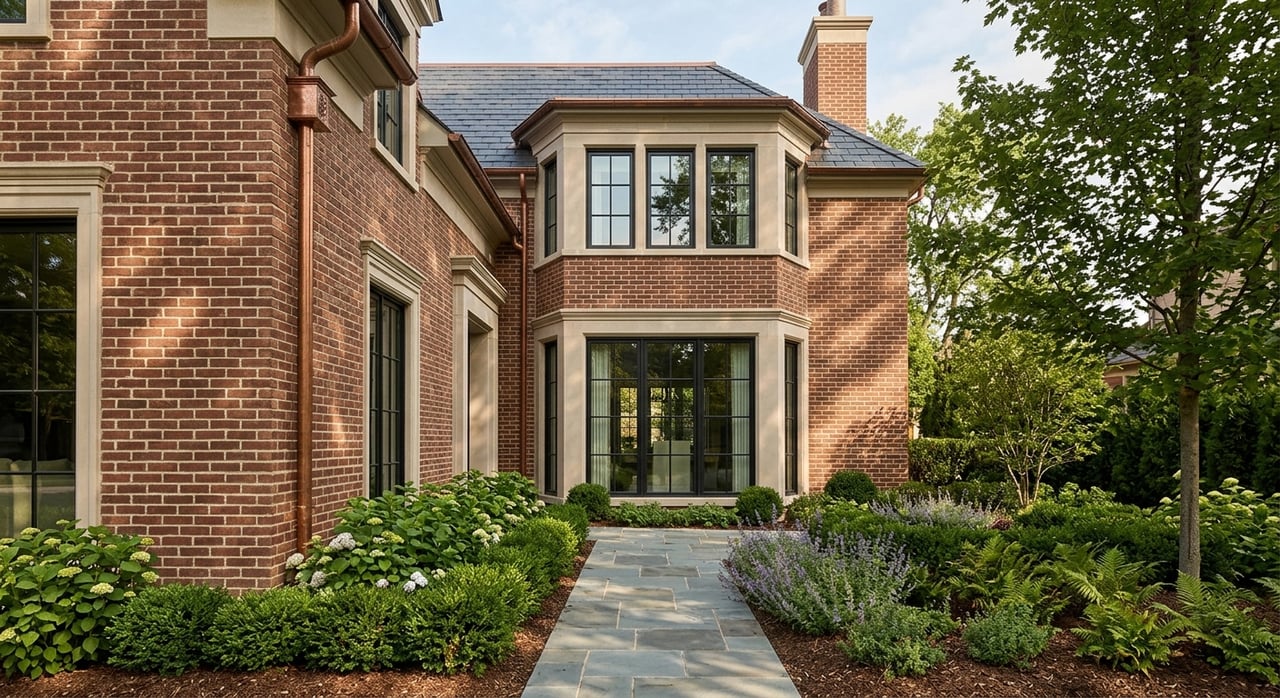
One of Glencoe’s defining strengths is its architectural range. Village materials cite Italianate, Queen Anne, Colonial Revival, Tudor, Prairie, Craftsman, International, ranch, split-level, and contemporary or neoeclectic homes. That mix means buyers can find very different design expressions within the same village.
Certain pockets are especially distinctive. The Greenleaf Historic Area includes homes built from 1860 to 1948, and Ravine Bluffs includes six Frank Lloyd Wright residences plus the village’s only Wright-designed bridge. Other notable pockets, including Keck and Keck and Strawberry Hill, help explain why one street can feel markedly different from the next.
For you as a buyer, this means it is important to judge homes in context. A beautiful house may still feel less compelling if it does not sit well on its lot or align with the surrounding streetscape. In Glencoe, fit and setting carry real weight.
What today’s market suggests
Recent snapshots point to a tight luxury market. Redfin reported a March 2026 median sale price of $2.0 million, up 50.9% year over year, with homes selling in 35 days. It also reported that many homes sold about 5% above list price, while especially sought-after homes could go pending in around 21 days and sell about 11% above list.
Realtor.com’s March 2026 snapshot reported a median listing price of $2.79 million, 29 homes for sale, a median 23 days on market, and a 100% sale-to-list ratio. Because Glencoe is a small market, monthly medians can shift sharply when only a limited number of homes close. The bigger takeaway is direction: this is a premium market where strong properties can move quickly.
Prepare before you start touring
In a fast-moving market, your preparation matters. If you are financing, having preapproval in place can help you move with confidence. Even if you are paying cash, a clear buying plan and readiness on timing and terms can make a difference when inventory is limited.
This is also the stage to define your tradeoffs. In Glencoe, common buyer decisions often come down to lake proximity versus train or downtown access, historic character versus newer construction, and lot size versus interior finish level. The clearer you are on your priorities, the more focused and effective your search will be.
Look closely at lakefront distinctions
Not every home near Lake Michigan offers the same value proposition. In Glencoe, there is an important difference between true frontage, a protected view corridor, and simple proximity to the shoreline. Buyers should verify those distinctions carefully on a parcel-by-parcel basis.
Nearby public access also matters in day-to-day life. Lakefront Park sits between Longwood Park and Hazel Avenue, overlooks Lake Michigan, and provides access to Glencoe Beach and the Perlman Boating Beach. If you are considering a home near the lake, it is worth understanding how nearby public use and seasonal patterns may shape your experience.
Renovation and rebuild plans need review
If you are considering a property for major renovation, expansion, or a future rebuild, Glencoe’s contextual design review framework should be part of your due diligence. The village reviews new work with attention to block-face conditions, adjacent homes, topography, trees, ravines, and other landscape elements. In other words, what you can envision and what the village may support are not always the same thing.
This is where a design-aware buying strategy can protect you. A home may be attractive because of the lot, but the real question is how that lot interacts with local review standards and the surrounding context. Understanding that early can save time, money, and frustration.
Schools and daily routines matter
For many households, daily logistics are a meaningful part of the buying decision. Glencoe School District 35 uses an age-centered model, with South School serving grades K through 2, West School serving grades 3 through 4, and Central School serving grades 5 through 8. New Trier Township High School District 203 serves Glencoe along with several other North Shore communities and says it serves about 4,000 students.
Whether or not schools are a major driver for your move, it helps to understand how the district structure works. Commute patterns, school transitions, and after-school routines can all influence which part of Glencoe feels most practical for your household.
Underwrite taxes with care
Property taxes are a major part of luxury home carrying costs, and they should be reviewed carefully before you make an offer. Cook County says property tax bills depend on a property’s assessment, the assessments of other properties, appeals, exemptions, and local tax levies. The Cook County Assessor’s Office also notes that the homeowner exemption can reduce a typical homeowner’s bill by about $950 per year on average, though eligibility must be verified.
That means you should not assume one tax bill tells the whole story. This is especially important when you compare older homes, newer construction, and properties that may have changed ownership recently. A strong purchase decision looks beyond the list price and into the full carrying cost.
Think about resale from day one
Even if you plan to stay for years, resale should still shape your search. In Glencoe, the strongest long-term resale stories are often tied to scarce land, lake or ravine setting, architectural pedigree, school alignment, and a home that is well integrated with its block and landscape context. Those qualities are difficult to replicate, which is part of what supports value over time.
This does not mean every buyer should chase the same type of property. It means you should understand why a home is compelling, and whether that appeal is likely to hold up when you eventually sell. In a nuanced market like Glencoe, quality is not just about finishes. It is about permanence, fit, and setting.
Buying well in Glencoe starts with clarity. When you understand the village’s layout, lot patterns, architectural mix, and market pace, you can evaluate opportunities with much more confidence. If you want a thoughtful, design-aware approach to your search, The Kasey Group can help you refine your priorities and navigate the market with discretion and precision.
FAQs
What should luxury buyers know about Glencoe before touring homes?
- You should understand that Glencoe is a land-constrained North Shore market where lot quality, setting, architecture, and access to amenities like Lake Michigan, downtown, and Metra can affect value as much as the home itself.
How competitive is the luxury home market in Glencoe?
- Recent March 2026 market snapshots suggest a tight market, with Redfin reporting a $2.0 million median sale price and 35 days on market, and Realtor.com reporting a $2.79 million median listing price, 29 homes for sale, and 23 median days on market.
What are the main differences between Glencoe neighborhoods for homebuyers?
- Glencoe’s areas differ by lot size, street pattern, and surrounding landscape, with East Glencoe generally offering larger lots and ravine settings, South Glencoe having smaller lots, and West Glencoe featuring more open surroundings near the Botanic Garden and Skokie Lagoons.
What should buyers verify about lakefront homes in Glencoe?
- You should verify whether a property has true lake frontage, a protected view corridor, or simply proximity to the shoreline, because those differences can meaningfully affect both lifestyle and value.
How do property taxes work for luxury homes in Glencoe?
- Cook County says tax bills depend on assessment, surrounding assessments, appeals, exemptions, and local levies, so buyers should review taxes carefully and verify whether any homeowner exemption may apply.
What should buyers know about renovating a home in Glencoe?
- If you are considering a major renovation or rebuild, Glencoe’s review framework emphasizes block context, adjacent homes, topography, trees, ravines, and other landscape features, so early due diligence is important.
How are schools organized for Glencoe residents?
- Glencoe School District 35 uses an age-centered model with South School for grades K-2, West School for grades 3-4, and Central School for grades 5-8, and New Trier Township High School District 203 serves Glencoe for high school.